
WEB app
|
2024-2026
National Australia Bank
date
November 2024 - March 2026
role
Senior Product Designer

Due to NAB’s portfolio restrictions I cannot share any confidential proprietary business information. All flows and interfaces shown are recreated to respect confidentiality.
From a week-long wait to an account that opens itself.
I identified an opportunity and secured funding by pitching to senior leadership. I led the design through three successful releases, boosting instant business trading account openings up to 28%.

Problem space
Anti Money Laundering (AML) law requires every director and beneficial owner verified before any business account opens.
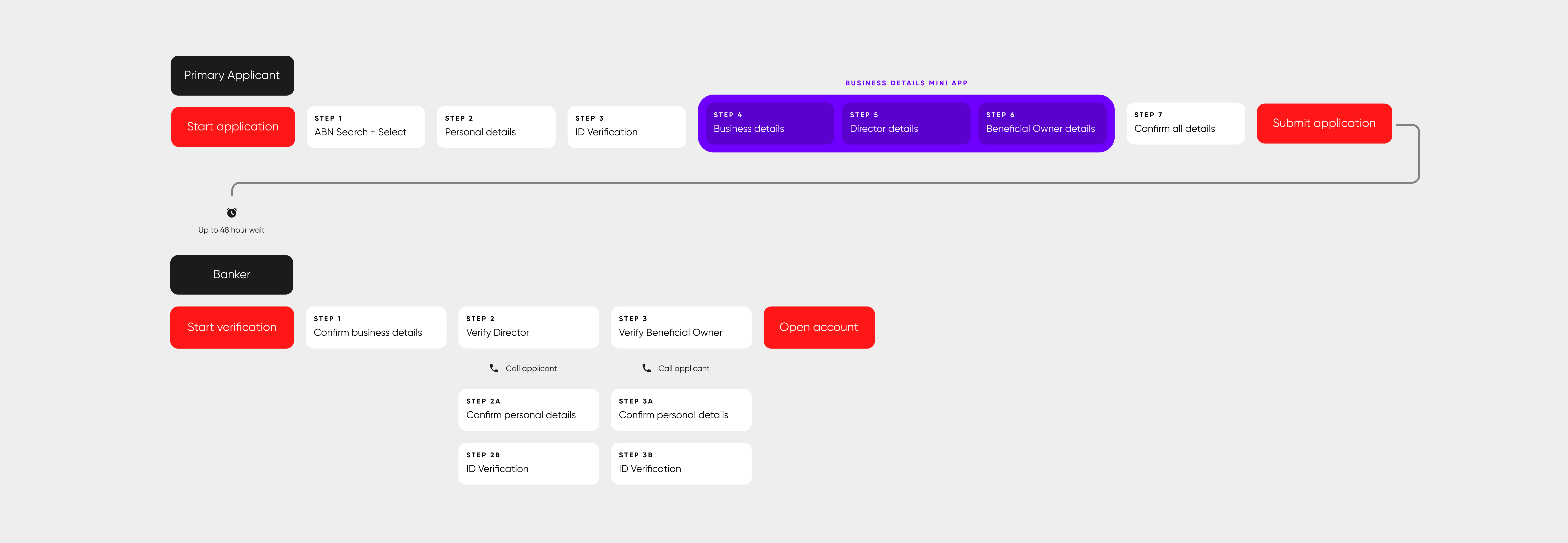
NAB could only collect details from the main applicant; a banker had to manually chase other applicants to verify their details. Around 30% of customers had simple multi-party structures needing no banker judgement at all. This was a process failure and fully automatable.
Three customer bands:
NAB could only collect details from the main applicant; a banker had to manually chase other applicants to verify their details. Around 30% of customers had simple multi-party structures needing no banker judgement at all. This was a process failure and fully automatable.
Three customer bands:
- Single-person businesses (already instant).
- Simple 2–4 party structures (the target, and the majority of multi-party applicants).
- Complex structures with trusts or other complex shareholdings (genuinely needing banker review; deliberately out of scope).
To win over the middle customer band, we had to solve a key dependency: letting third parties verify themselves with NAB.
Proposal
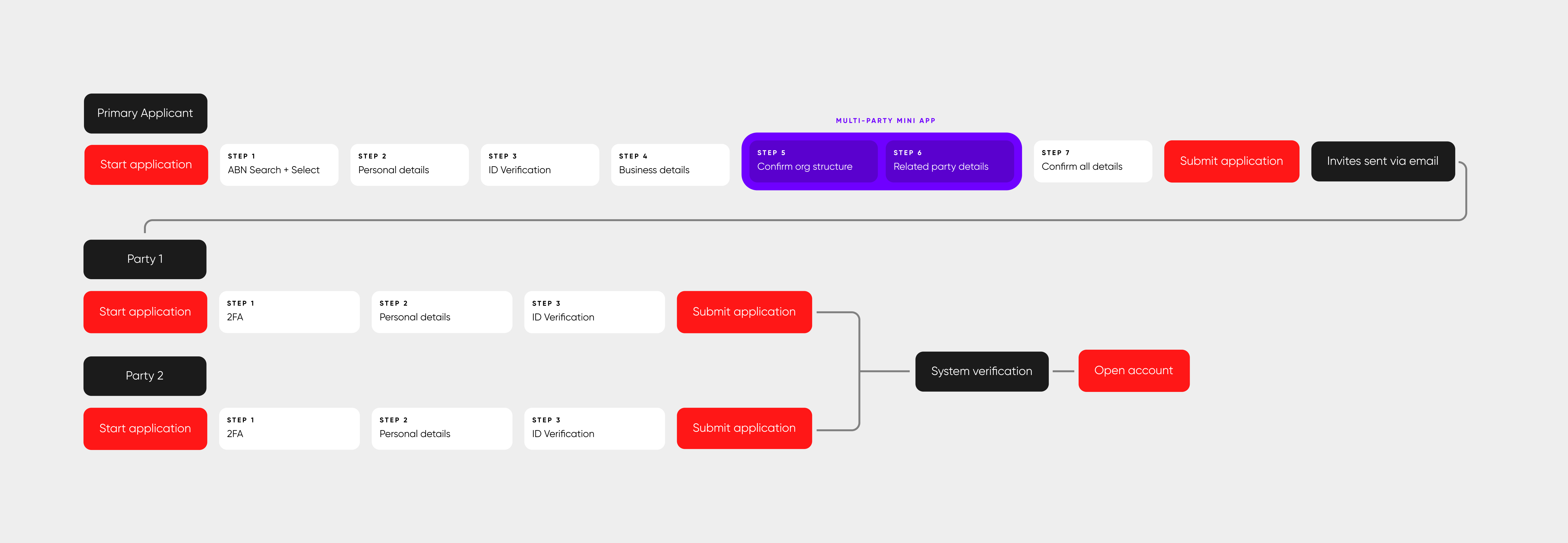
I created a two-part pitch: one comparing current and proposed user flows to quantify saved banker hours, and the other testing concepts with customers. Stakeholders respond better to seeing and hearing real user feedback rather than just reading projections. This approach secured buy-in and budget.
An external consultancy conducted a six-week sprint across the entire business, covering transaction accounts and lending. Their expansive vision helped us refine our focus, shaping our scope and design challenges.
An external consultancy conducted a six-week sprint across the entire business, covering transaction accounts and lending. Their expansive vision helped us refine our focus, shaping our scope and design challenges.
Refined scope
Launch big for impact, or small to de-risk.
I argued for the highest-volume business product; the org chose low-volume product: nabtrade, as the higher volume products were undergoing a design system uplift. I negotiated a dual track: ship in the legacy design system now, seed the pattern into the new design system for the team that scales it.
One success metric we could actually own: straight-through processing (STP) rates.
Accounts opened with zero banker involvement. Completion and error rates were rejected as measures: other launches would move those numbers for reasons unrelated to our work. STP isolated our impact.
Three releases, phased around the boundary of what could be automated.
Release one: Re-architected the forms mini-apps so we had foundations to build multi-party functionality.
Release two: Delivered the core multi-party functionality, allowing external parties to self-verify against ASIC. This was the linchpin for the STP case.
Release three: Introduced trusts, intentionally saved for last as a manual workflow.
Release two: Delivered the core multi-party functionality, allowing external parties to self-verify against ASIC. This was the linchpin for the STP case.
Release three: Introduced trusts, intentionally saved for last as a manual workflow.
Design problems
high impact
Primary applicants struggled to recall personal information of other applicants.
The old flow made the primary applicant supply everyone's dates of birth, addresses and details. This was just collecting and not verifying, every check fell to a banker despite NAB owning the ID verification tech.
MEDIUM impact
One application, multiple parties.
How might we give primary applicants full visibility and control over joint applications?
LOW impact
Bankers still had to chase applicants for trust deeds.
As trust deeds required manual verification, we couldn't fully automate the trust flow. Bankers still had to chase applicants over email to retrieve the documents.
Solution
Released
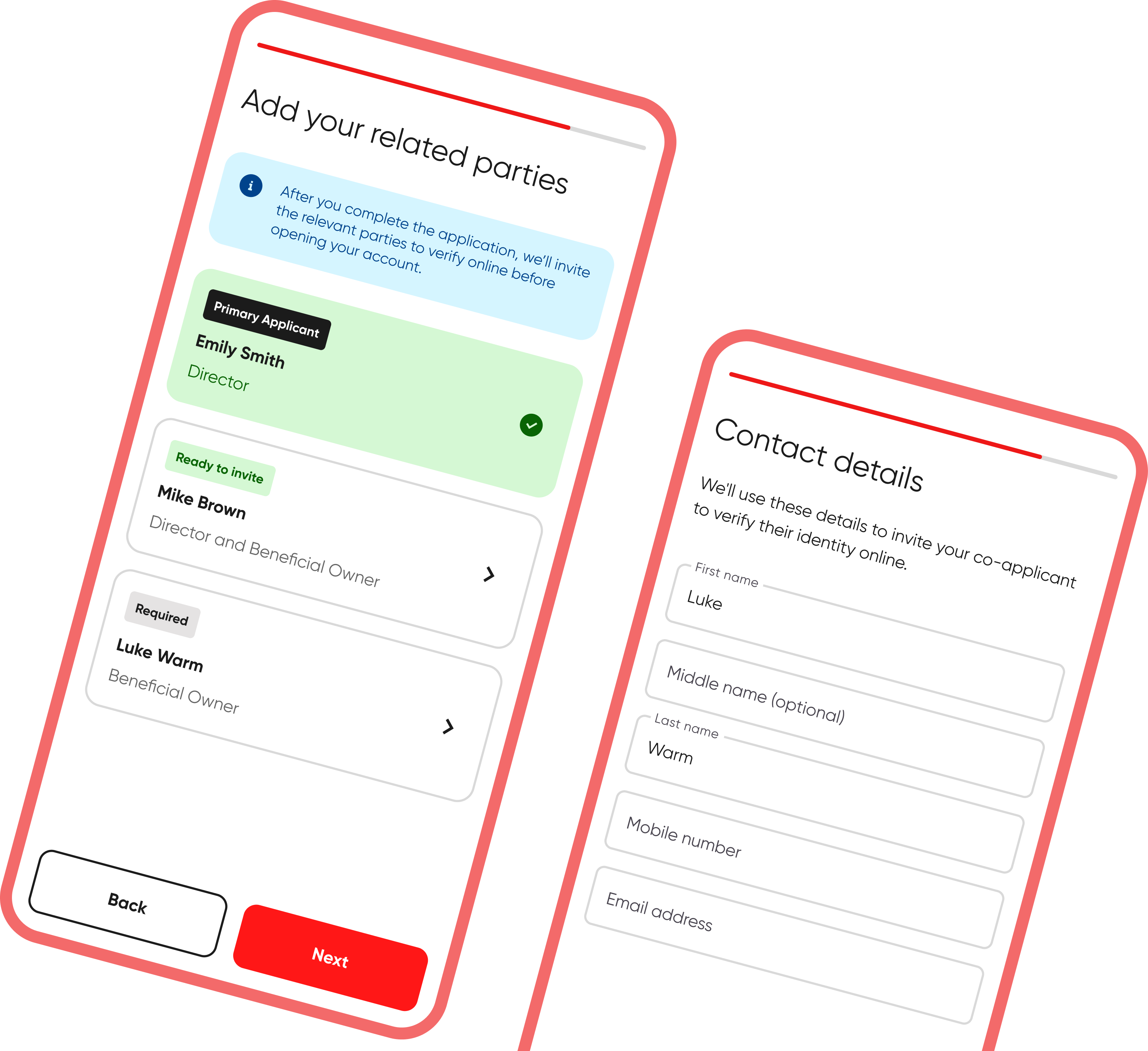
Ask only what anyone recalls in seconds.
Only collect the contact information for the invitation. Then give every person their own entry point to verify themselves, anywhere, anytime.
Rescoped
A hub for visibility and control.
A central dashboard enabling primary applicants to track co-applicant progress, fix contact errors, and resend invitations seamlessly.
RESOLVED FOR BUILD
While user testing validated the application hub concept, build costs made it infeasible for launch.
We pivoted to using EDM (email) flows as our core hub: progress tracking, status updates, and reminders.
We pivoted to using EDM (email) flows as our core hub: progress tracking, status updates, and reminders.
THE TRADE OFF
Dropped the re-invite functionality. The right cut to focus on delivering Release two on schedule.
Resolved for scale
Let customers upload the trust deeds in-flow.
We added in-app trust deed uploads to cut out banker emails and boost security. While it didn't lift STP rates right away, it laid the groundwork for future AI verification.
Results
28%
of nabtrade applications achieve straight-through processing.
(Opening an account without banker involvement)
4.35/5
ExQual Score
(NAB's version of quality scoring)
Reflection
What I’m proudest of isn't just the final outcome, but that I identified this design opportunity myself.
What began as a push to improve both customer and banker experiences grew into a fully funded, phased initiative. All because clear diagrams and concept testing made the cost of doing nothing impossible to ignore.
While our rollout sequence shifted from the original plan, finding a pragmatic middle path, shipping within the legacy system while planting the seeds for the new architecture allowed us to build a scalable foundation designed for continuous improvement.
What began as a push to improve both customer and banker experiences grew into a fully funded, phased initiative. All because clear diagrams and concept testing made the cost of doing nothing impossible to ignore.
While our rollout sequence shifted from the original plan, finding a pragmatic middle path, shipping within the legacy system while planting the seeds for the new architecture allowed us to build a scalable foundation designed for continuous improvement.
